The scientific sector is in a period of significant transformation. A combination of funding pressures, rapid technological advancement, and evolving employee expectations is reshaping the employment market. For organisations to attract and retain the specialist talent needed to drive innovation, they must understand these shifting dynamics. From the struggles of established biotech companies to the exponential growth of computational biology, the landscape for scientific professionals is more complex than ever.
Biotech's funding squeeze and its ripple effect
Over the last year, we have seen a number of companies struggle to obtain funding, particularly within the biotech sector's ‘Golden Triangle’ of Cambridge, Oxford, and London. While it's common for startups to face a volatile funding environment, we're now seeing more established companies - those that have successfully navigated initial funding rounds - grapple to secure their next phase of investment.
This led to a difficult but necessary stripping back of headcount and, consequently, a notable number of redundancies. The result, as we enter 2026, is a market flooded with highly qualified and experienced scientists. While this may seem advantageous for hiring companies, it presents a new set of challenges. Employers are receiving a high volume of strong applicants. But, this abundance of talent makes it harder for organisations to sift through applications and for jobseekers to stand out in a crowded field.
Professionals impacted by these changes are adapting by diversifying their skill sets and broadening their career horizons. Lab-based scientists are increasingly looking for roles where they can leverage their academic qualifications and industry experience in a more commercial capacity. And, we are seeing a rise in individuals exploring opportunities in business development, sales, and technical support, moving to roles that still require deep scientific knowledge but where they can apply it in a different context.
The rise of the data-driven scientist
While some areas face headwinds as we enter the new year, others are experiencing unprecedented growth. The most significant shift is the increased demand for professionals in computational biology and bioinformatics. These roles represent a move from the ‘wet lab’ to the ‘dry lab’, where scientists use computational data to interpret trends and make predictions.
Most professionals in this field start with a degree and perhaps a master's in a biological science before pursuing a PhD in computational biology. This combination of deep scientific understanding and advanced programming and data analysis skills is highly sought after. Historically, this work might have been outsourced, but today, most biotech and pharmaceutical companies are building their own in-house computational teams. This has created a surge in demand for talent that can bridge the gap between biology and computer science.
Alongside this, we're witnessing rapid growth in app-based health technology. More companies are leveraging digital platforms to monitor and diagnose health issues, such as diabetes, through user-friendly mobile applications. A key advantage of these technologies is their ability to reach and support a much wider audience, providing access to health monitoring and guidance with far greater efficiency than traditional dependence on in-person GP visits. This digital approach enables patients to manage their conditions remotely, allows for continuous data collection, and helps healthcare providers deliver timely interventions without geographic limitations.
At the same time, the field of precision medicine is advancing quickly. Biotech companies are now able to develop treatments that target specific genes or cells, offering highly personalised therapies for complex diseases such as cancer and neurological disorders. These breakthroughs mean that approaches to treatment can be tailored to an individual's unique genetic profile, improving outcomes and minimising side effects.
Together, these innovations point to a future where technology and data not only enhance healthcare delivery but also revolutionise our ability to predict, prevent, and treat serious illnesses with unprecedented accuracy. The common thread is the integration of technology and data, signalling a clear direction for future innovation and talent acquisition.
Flexibility, automation, and the new shape of scientific roles
The conversation around remote and flexible work has evolved differently in the scientific sector. For lab-based roles, working from home is simply not feasible. However, that doesn't mean flexibility is off the table. Instead of remote work, the focus has shifted to flexi-time. To help employees avoid peak traffic in innovation hubs like Cambridge, many labs now operate on extended hours, allowing staff to start earlier or finish later. This operational adjustment provides the flexibility needed to improve work-life balance without compromising essential onsite duties.
For non-lab roles in areas like bioinformatics, the story is entirely different. These professionals can often work from anywhere, and companies are embracing this, requiring on-site presence as little as once or twice a quarter.
When it comes to automation, we are seeing a complete overhaul of the laboratory itself. A single machine can now run thousands of tests in an hour - a task that would have previously required a team of scientists working for a full day. While this speeds up processes immensely, it reduces the need for hands-on lab staff. However, it also creates new roles. There is a growing demand for specialists who can manage, validate, and maintain this sophisticated equipment. These roles, such as field service engineers and application scientists, require a unique blend of scientific knowledge and technical expertise to install, repair, and train others on the use of automated systems.
An uptick in temporary and contract-based hiring
In response to market uncertainty, particularly around funding, there has been a significant rise in temporary and contract-based roles across all specialisms and seniorities. For employers, this offers a way to access skilled professionals for specific projects without the long-term commitment of a permanent hire. It provides agility in a volatile environment, allowing them to bring in expertise to get a project over the line and then re-evaluate their needs.
This trend is also beneficial for professionals. In a competitive job market, contract work provides an immediate income stream and a way to stay engaged with the industry. It also offers a degree of flexibility for professionals who may be hesitant to commit to an organisation whose long-term funding is not guaranteed. This mutual benefit has created a thriving contract market, with both parties recognising and embracing the opportunity.
Salaries and benefits
Despite the competitive market, salaries in the scientific sector are generally holding strong and increasing in line with market fluctuations. An interesting development is that some people are even lowering their salary expectations to position themselves more attractively.
However, for many scientists, compensation is only one part of the equation. They are often more driven by a passion for their work and the opportunity to contribute to meaningful research. As a result, they are increasingly asking "what else?" when considering a role. Benefits packages, including robust pension schemes, private healthcare, and share options - particularly in startups - are crucial differentiators. While startups may not have the established benefits of a large corporation, they can offer significant rewards through share options if the company succeeds.
It's a balancing act, and employers who present a compelling total package are best positioned to attract the best talent.
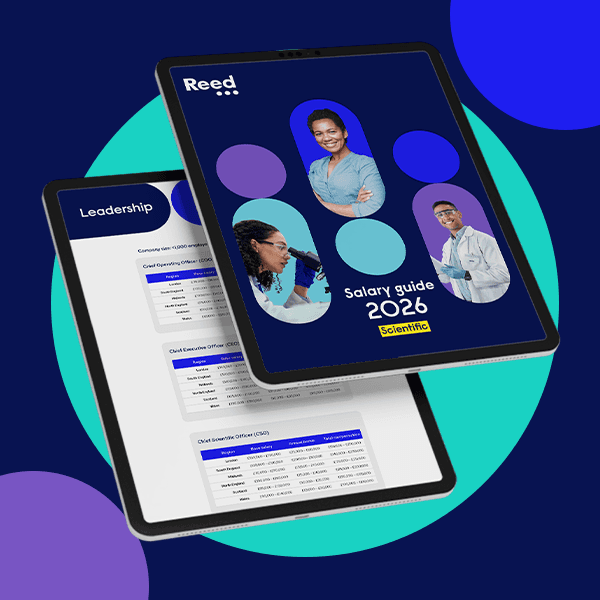
For more insights into the scientific labour market and for reliable salary benchmarks for the sector, download Reed's 2026 scientific salary guide here.