The procurement and supply chain sectors are at a pivotal moment. After years of disruption, businesses are now navigating a landscape defined by economic caution, technological advancement, and shifting workforce dynamics. As we progress further into 2026, companies will have to rethink their strategies to build resilience, control costs, and attract the right talent. Success will depend on a nuanced understanding of these evolving trends, from the skills in demand to the growing importance of sustainability.
A cautious market creates new hiring dynamics
During 2025, a sense of caution settled over the hiring market for procurement and supply chain. We observed a bottleneck effect, where changes at the strategic level were causing a slowdown across the board. When senior leaders depart and aren't immediately replaced, it creates a ripple effect, stalling movement at the semi-senior and transactional levels. This led to a slower marketplace compared to previous years, particularly within corporate purchasing functions.
In this climate, many organisations are looking to consolidate roles to manage costs. It's becoming more common for businesses, especially manager-owned SMEs, to seek a single professional who can oversee both procurement and supply chain functions. Instead of having separate supply chain and procurement managers, they are hiring one person to manage both worlds, creating a more integrated but demanding role.
This trend has consequences for mid-level professionals. While there is still demand for transactional ‘doers’ like buyers and senior buyers, those at the middle-management level are finding fewer opportunities as we enter 2026. Companies appear to be flattening their structures, with more junior staff reporting directly to higher-grade leaders, effectively squeezing out the middle layer.
The skills defining the future of procurement
As technology, particularly AI, becomes more integrated into business operations, the skills that employers value are evolving. While digital literacy is undoubtedly crucial, the human element remains irreplaceable, especially in procurement.
AI can draft emails and analyse data, but it cannot replicate the nuance of human interaction required for effective negotiation and relationship management. As such, we have seen a marked increase in demand for professionals with strong negotiation skills. Companies need individuals who can go onsite, challenge suppliers on quality, and secure better terms. This physical presence and ability to build rapport are skills that technology cannot replace.
Bringing operations in-house
Another significant trend is the move to bring specialised functions, such as freight forwarding and customs, in-house. Many manufacturing and retail businesses that previously outsourced these activities are now building internal teams to manage them. The primary driver is cost control. While transit costs for shipping remain, bringing the management of these processes in-house eliminates the fees paid to external forwarders.
This has created a surge in demand for professionals with experience in import, export, and customs compliance. Roles within freight forwarding and logistics remain high on the agenda, as businesses recognise the value of controlling these critical supply chain elements themselves. I predict this trend will continue throughout 2026, with more companies investing in internal expertise to streamline their operations and reduce expenses.
The growing influence of ESG
Environmental, social, and governance (ESG) considerations have shifted from being a peripheral concern to a core element of modern procurement and supply chain strategy. Today, ethical sourcing and sustainability are not optional - they are fundamental to decision-making, driven by rising consumer expectations and the need to mitigate business risk.
For business leaders, sourcing sustainable products is no longer a competitive advantage; it’s a matter of survival. Companies that fail to adapt risk severe disruption - supply chains can stall if goods cannot move or sell due to non-compliance with environmental standards. From a talent perspective, sustainability is equally critical. Professionals increasingly consider an employer’s long-term commitment to ESG before accepting a role, avoiding organisations that lack credible sustainable practices.
Ethical sourcing has also taken centre stage. Reports of unethical practices can trigger reputational damage and legal consequences. As a result, risk management now dominates procurement conversations, with ESG considerations close behind. A company’s ethical footprint has become a defining part of its brand identity, and professionals skilled in ESG reporting and ethical sourcing are in high demand.
This focus on risk extends to supplier diversity. Businesses are learning that dependence on a single overseas supplier creates significant vulnerability. Building a broader, more resilient supplier base is no longer optional - it’s essential for mitigating risk and ensuring continuity.
Salary expectations vs. market realities
In today's cost-conscious environment, salary negotiations have become a significant challenge. Many employers are offering salaries that encourage a sideways move rather than providing a financial incentive for people to switch roles. A job advertised at £40,000 to £45,000 may struggle to attract the best people for the job, as those individuals are likely already earning at the top of that bracket.
This creates a standoff. Most professionals are unwilling to change jobs for the same salary unless there are other compelling benefits. For employers, this means they need to ask themselves: "Why would someone join our company for the same pay?" If salaries are kept at the market level, the overall proposition must be attractive.
Beyond the payslip
When salary increases are off the table, other benefits become crucial. Flexibility is a key differentiator. While hybrid working is less common in procurement and supply chain due to the hands-on nature of the roles, offering even one day a week from home can be a powerful incentive. It saves the employee money on commuting and offers a better work-life balance.
However, in the SME world, benefits packages are often quite basic and similar from one company to the next. This puts the pressure back on salary.
Addressing critical skills shortages
Acute skills shortages persist in specific areas, most notably in freight forwarding, customs, and import/export. This shortage is largely due to an ageing demographic and a lack of investment in new talent.
Many businesses in this sector are so busy that they cannot find the time to train apprentices or junior staff. When an experienced employee leaves, they take skills and experience out the door. Companies feel they don't have the luxury of training someone new who doesn't understand the complexities of air versus ocean freight, or the intricacies of customs documentation.
This failure to nurture talent at the entry-level means the workforce is getting progressively older. Employers need to shift their mindset from demanding 10 years of experience to recognising the potential in applicants who are two or three years behind and can grow into a role. This approach not only addresses the skills gap but also fosters loyalty and longevity.
The human factor in an automated world
While automation and Industry 4.0 are transforming large-scale operations, their impact on smaller businesses is less pronounced. For a small wholesaler with a modest warehouse, the cost of implementing sophisticated robotics like those seen in Amazon's fulfilment centres is simply not viable.
As a result, the demand for human workers in these environments remains strong. Many business owners still prefer the reliability and experience of a skilled forklift driver over a programmed machine, especially when considering insurance and operational risks. For the foreseeable future, automation will likely remain the domain of large-scale enterprises, while small and medium-sized businesses will continue to rely on a human workforce. This ensures that jobs in these areas are not at immediate risk from technological displacement.
A look to the future
To succeed in 2026, businesses in the procurement, supply chain, and industrial sectors must adopt a more flexible and forward-thinking approach to talent.
Organisations need to be more open-minded. This means being realistic about salary expectations, offering flexibility where possible, and being willing to invest in potential. Rather than seeking a like-for-like replacement for a departing employee, consider hiring someone with the capacity to grow. By providing opportunities and training, you not only fill a vacancy but also build a more engaged and loyal workforce. In a market defined by caution at the end of 2025, an investment in people remains the most secure path to long-term success in 2026 and beyond.
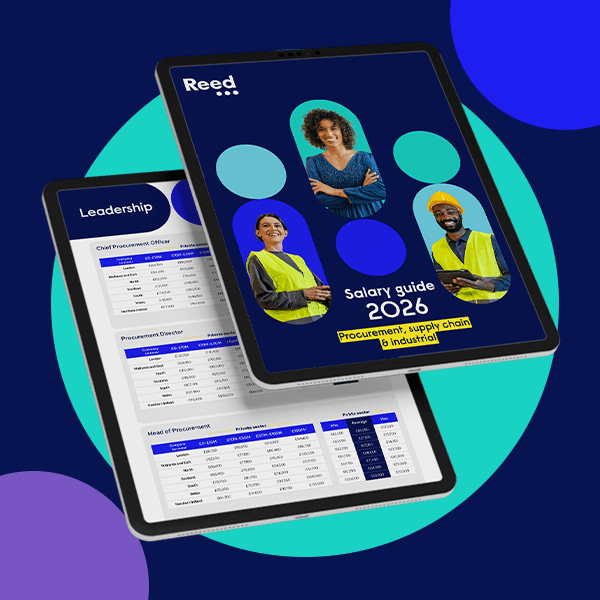
For more insights into the procurement, supply chain and industrial labour market and for reliable salary benchmarks for the sector, download Reed's 2026 procurement, supply chain and industrial salary guide here.