
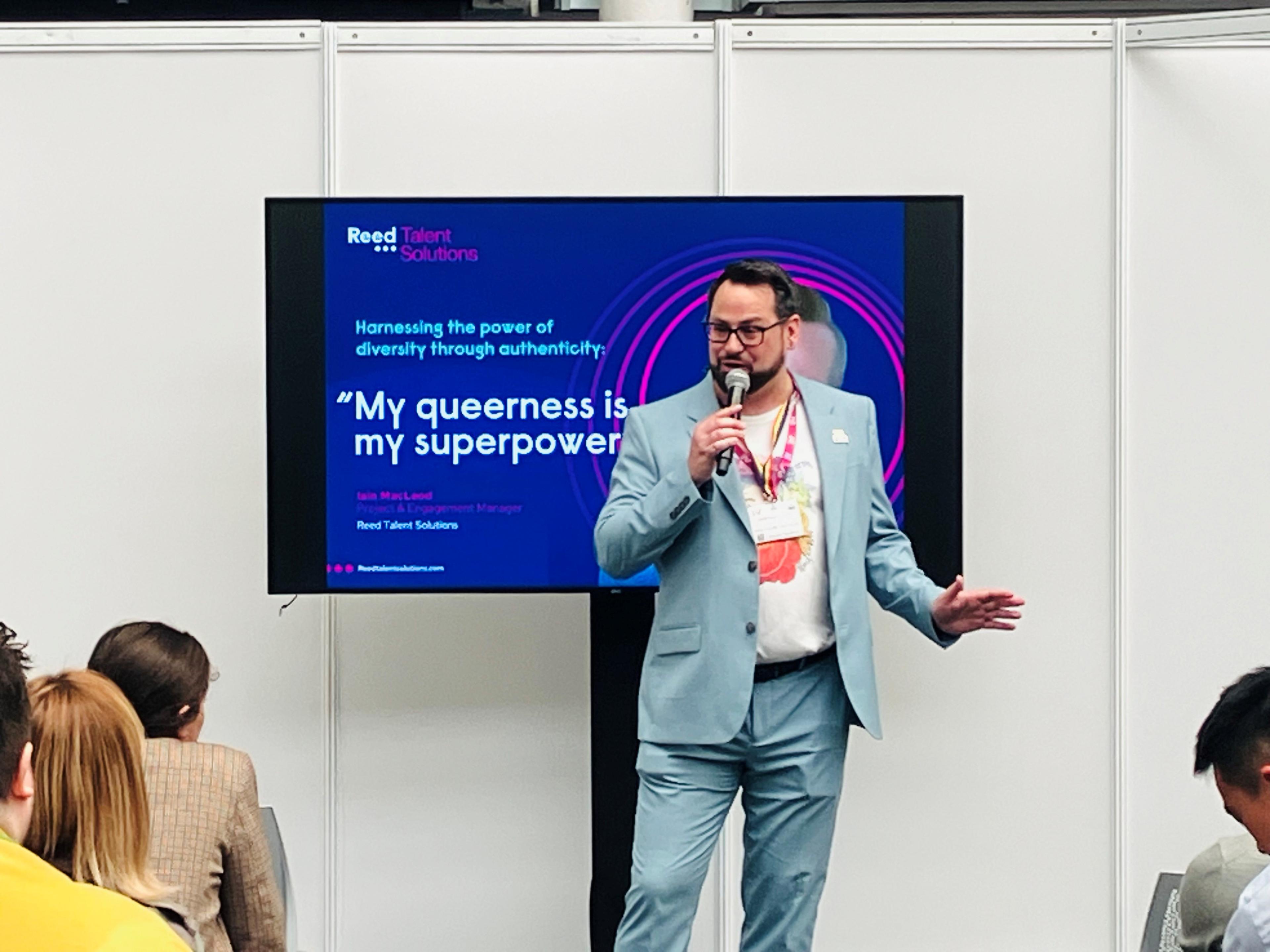
Iain has long been one of the many driving forces in amplifying our co-member voices within equality, diversity, inclusion and belonging. He shares how being able to bring his specialist knowledge to co-members and customers alike is what drives him.
What motivated you to join Reed Talent Solutions, and how has your experience been so far?
In an oft repeated story, I kind of fell into the wonderful world of recruitment. Knowing I was underappreciated and unsatisfied in the job I was working, a friend of mine who was a Reed co-member told me of a position available in his team. Almost 12 years, a funded qualification, and a change in role later, I am still here and thriving.
How do you define inclusion and belonging, and what role do they play in Reed?
I read a quote a long time ago and it guides how I approach this subject. “Diversity is a fact. Equity is a choice. Inclusion is an action. Belonging is an outcome.”
What this means is that if you accept diversity as a fact (we all have unique and diverse backgrounds, stories, and experiences), make the choice to create equitable opportunities, and take inclusive action, the outcome will be a space where people feel like they belong.
At Reed strive to ensure that our co-members can bring their whole self to work every single day. We can only do this by taking an authentic, people-centred approach to our inclusive action.
What are some of the challenges you have faced while working with clients on inclusion and belonging initiatives, and how did you overcome them?
One of the biggest inclusion challenges that many clients face is knowing where to start. The business case for a robust Diversity, Equity and Inclusion (DE&I) function is clear, but how can a client make meaningful, authentic change rather than just take reactionary responses? The first step for me is to ask, “What problems are you facing?”, now that problem doesn't need to be organisation specific, it could be something that affects the entire sector. The key to overcoming that is to ensure a client understands inclusion is not something you can ever complete. It isn’t a single project, or a fixed figure, or percentage to hit and you’re done. It is something to be weaved into all parts of your organisation, that needs to grow and change as both the company and world changes.
What are some of the best practices that you follow to promote diversity and belonging in the workplace?
When it comes to best practice, my biggest recommendation is to be honest and own where you are on your inclusion journey. This applies to both organisations and individuals. No individual can know everything, as nobody has lived all human experiences. From an organisation point of view, if you aren’t where you want to be on any metrics, be open about it. Investigate potential reasons, engage with as diverse a pool of employees as you can, and listen to their advice. I would much rather work for an organisation that says, “We aren’t where we want to be yet, but we are taking these steps to get there”, than one that says, “We’re great at this”, but fails to live up to their promises. This is something we at RTS can help with. Our DE&I Audit is designed to look at where clients are excelling and where they have room to grow.
Secondly, I would advise to stop talking ‘you and me’’ and start using the term “we”. We all benefit from greater diversity in organisations. Whether its financial performance, innovation, problem solving, or reputational growth; time and again the evidence shows the benefits that having a diverse group of people working together to a common goal will bring.
Finally, I would say don’t let perfect be the enemy of good. Do not rush to achieve some glittering level of perfection, without taking the time to make sure that your small steps forward are working and getting you closer to where you want to be. Progress is not linear, you will get things wrong, but this is how we all learn. Don’t be afraid to get it wrong, and when corrected take that onboard with gratitude. Do the best that you can with the knowledge that you have, and when you know better, do better.
How supported by Reed have you felt to work towards your EDIB goals?
Early on in my life at Reed, my manager saw that not only did I have passion for all things inclusion, but I had skills and experience in the field. She supported, nurtured and encouraged this. She pushed me to speak up and lead conversations. Her confidence in me truly counteracted the imposter syndrome. This was not a one off. Successive managers and directors within Reed have not only encouraged me to keep striving forward, but they have also supported me by amplifying my voice, investing in my training, and championing my work.
What are your hopes for progress within I&B for Reed in the future?
We have done so much great work internally at Reed, so I’m really excited to bring this both to our clients and to the wider market. As a provider of talent solutions, from individual placements to complex multi-layer projects, we are perfectly placed to utilise the knowledge of our EDI&B experts to improve lives through work.